Arsenal Women Mailbag: My Starting Midfield, London’s Spanish Rivalry And Why Man United Concern Me Less
Answering your Arsenal Women questions this week

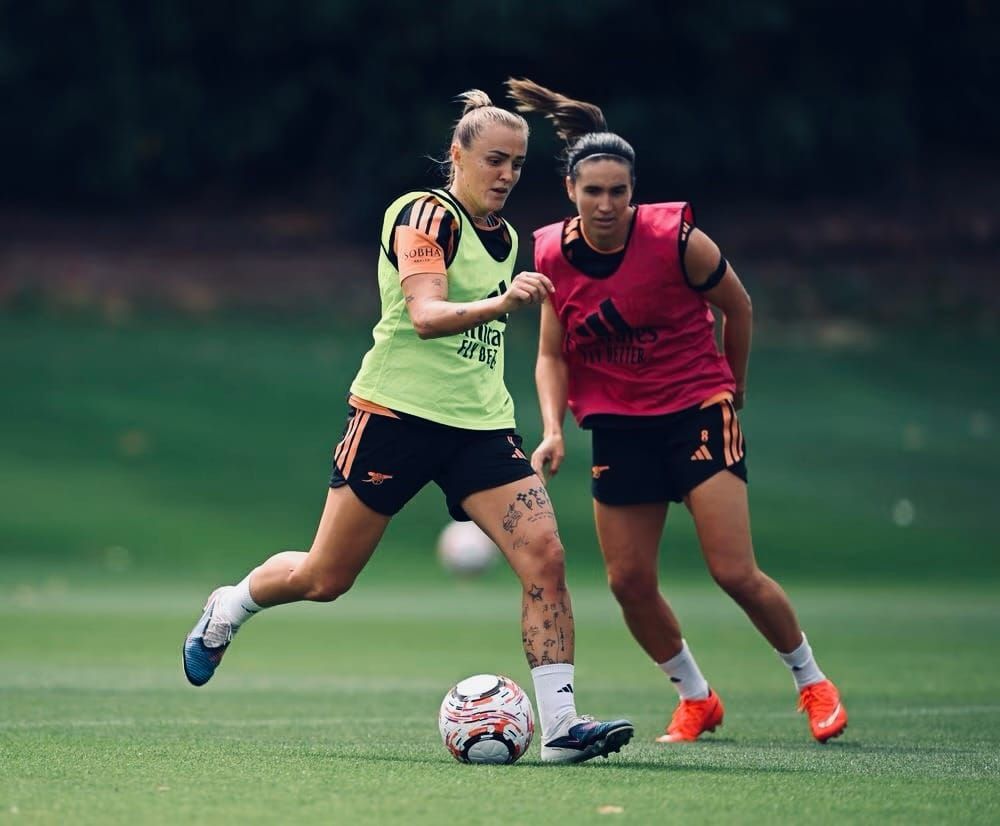
One of the things I’ve really enjoyed over the last few weeks is seeing the Trailblazers community start to grow. Every week I ask for your thoughts over on Instagram and, without fail, some of you come up with questions that genuinely make me stop and think. A couple of this week’s questions actually kept me awake the night before recording because I couldn’t quite decide what I thought the answer was, and I suppose that’s exactly why I enjoy doing this part of the podcast so much. Rather than simply talking at each other, we’re starting to have proper conversations about Arsenal Women, and that’s exactly the sort of community I hoped we’d build when I started Trailblazers.
So, let’s work through a few of the questions that landed in my inbox this week.
The first came from the brilliant Arsenal Women Chat Show, who asked what I think Arsenal’s starting midfield three will be this season. Honestly, I think this is probably one of the hardest areas of the team to predict because Renée Slegers suddenly has an embarrassment of riches in the middle of the park. You look at the options now and you’ve got Kim Little, Mariona Caldentey, Georgia Stanway, Frida Maanum, Geraldine Reuteler and, when she’s ready to return, Kyra Cooney-Cross. That’s before you even start thinking about players who can drift inside from wider positions.
If I had to pick the team for the opening game tomorrow, though, I think I’d go with Kim Little, Mariona Caldentey and Georgia Stanway.
For me, Georgia simply has to start. We’ve spoken so much over the last few weeks about what she brings to this Arsenal side, not just technically but physically as well, and I think she’s exactly the midfielder Arsenal have been missing. I’d be tempted to play her as the deeper of the three, allowing Kim and Mariona to operate slightly further forward where their intelligence and creativity can really influence the game. I think Kyra will probably spend the early part of the season easing back into things after everything she’s had to deal with personally over the summer, while Geraldine Reuteler and Frida Maanum give Renée outstanding options from the bench and across what is going to be another long campaign.
The next question came from Georgie Jord in Australia, and I absolutely loved this one because it made me think about something I hadn’t really considered before.
Georgie asked whether Arsenal’s growing Spanish contingent, compared with the number of Spanish players now at London City Lionesses, could actually influence the way the two clubs play this season.
It’s a fascinating question because, on the face of it, both clubs now have a significant Spanish influence. Arsenal have Mariona Caldentey, Ona Batlle and Misa Rodríguez, while London City Lionesses have assembled an incredibly impressive group including Alexia Putellas, Mapi León and Jana Fernández. Add in a few more Spanish internationals around that core and it’s very easy to assume that both teams will naturally begin to resemble Liga F sides.
I’m not entirely convinced that’s how football works. For me, nationalities matter far less than footballing ideas.
Renée Slegers isn’t suddenly going to build Arsenal around Spanish football simply because she has three Spanish internationals. Equally, London City Lionesses won’t automatically become Barcelona because they’ve recruited players who’ve spent their careers there. Managers build teams around principles rather than passports.
Where I do think it becomes interesting is in the individual battles.
Misa has spent years facing Alexia Putellas while playing for Real Madrid. Mariona and Ona know Mapi León and Jana Fernández inside out through both Barcelona and the Spanish national team. These players know each other’s strengths, weaknesses and habits better than almost anyone else in the league.
That familiarity could make those meetings between Arsenal and London City absolutely fascinating. At the same time, I still think Arsenal have something London City are going to need time to develop.
Versatility.
One of the things we’ve spoken about repeatedly throughout this summer is that Arsenal haven’t simply recruited talented footballers; they’ve recruited players capable of operating in multiple positions and adapting to different game states. That’s one of the reasons I think Arsenal will hit the ground running a little quicker than London City, despite all the excitement surrounding their transfer window.
Georgie also asked another question that I know has been on the minds of a lot of supporters. She wondered whether our start to last season ultimately cost Arsenal the Women’s Super League title and whether getting off to a fast start this year is absolutely essential.
I understand why people feel that way, but I actually think it’s slightly more complicated. I don’t necessarily think it was the start of the season that cost Arsenal the league, I think it was individual games.
When you’ve only got twenty-two league matches, as we did last season, every dropped point carries enormous weight. The draws against Brighton, Tottenham and Manchester United weren’t costly because they happened at particular points of the season. They were costly because every single point matters so much in a shorter league campaign.
Of course a strong start helps. It builds confidence, creates momentum and puts pressure on everybody else. But equally, a poor afternoon in February counts exactly the same as one in September.
That’s why I try not to get too caught up in narratives around “fast starts”. I’d rather Arsenal simply become relentlessly consistent.
BadgerCyclist, over on Instagram, asked what I thought about the opening fixtures, and I think we’ve probably covered most of that already. Brighton away is never going to be straightforward, Crystal Palace at home feels like a really nice first match at the Emirates, and then we very quickly discover exactly where Arsenal are when Manchester United and Chelsea arrive.
He also reminded me that, because of his username, he’s still insisting on calling Ona Batlle “Ona Badger.”
I’ll let him get away with it but just don’t expect me to start saying it myself.
Finally, Katherine McKee in Ireland asked a question that I thought was a brilliant way to finish because it made us step outside the Arsenal bubble for a moment.
She said she couldn’t help feeling for Manchester United and wondered how they’re going to put together enough squad depth to compete this season.
It’s easy to spend all our time analysing Arsenal in isolation, but sometimes the best way to understand where Arsenal are is by looking at the clubs around them. When I actually sat down and worked through Manchester United’s squad, I came away slightly less concerned for them than I expected to be.
Defensively, I actually think they’re in decent shape. Maya Le Tissier remains one of my favourite centre-backs in the WSL, Andrea Medina looks like a very exciting addition from Atlético Madrid, and they’ve got enough experience across the back line to remain competitive.
Their midfield still contains players capable of causing problems as well. Ella Toone, Hinata Miyazawa and Jess Park are all footballers I’d happily watch every week regardless of who they played for.
Where I think there are more legitimate questions is further forward. That’s the area that feels a little thinner than I’d expect from a club hoping to challenge at the top end of the table, and when I compare that with what Arsenal have assembled this summer, the contrast is striking.
Arsenal now have genuine depth almost everywhere. Renée Slegers can rotate without dramatically weakening the team. Different players bring different qualities. Different tactical approaches become possible depending on the opposition and that’s a really healthy place for Arsenal to be.
Could Manchester United still make life difficult for us? Absolutely! They already did last season. But when I compare the two squads now, I think Arsenal have moved further ahead.
And that’s probably the biggest thing I’ve taken away from this entire summer - we’re no longer building a squad simply capable of competing. We’re building one capable of adapting, rotating and, hopefully, sustaining a title challenge across an entire season.
That’s a very different conversation to the one we were having twelve months ago, and I have to say, it’s one I’m enjoying a lot more!