Renée Slegers and the Arsenal She’s Building
What Renée Slegers’ pre-season interview tells us about Arsenal Women’s new signings, emerging partnerships and the team she is building for 2026/27.

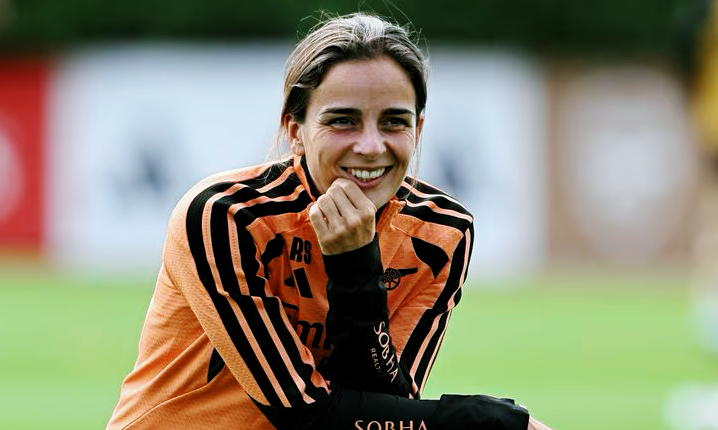
I’ve spent a lot of this pre-season doing what I suspect you’ve probably been doing as well, which is looking at all these new Arsenal players, looking at the players who were already here, moving imaginary pieces around an imaginary football pitch and trying to work out what Renée Slegers is actually going to do with everybody, and I’m beginning to think focusing on what our starting eleven against Brighton when the WSL season finally kicks off is the wrong thing to expend our energy on.
Well, not completely wrong, because obviously at some point Renée does have to select eleven players and apparently the authorities remain stubbornly opposed to Arsenal simply fielding all of them at once, but after listening to Renée’s big pre-season interview this week, and then thinking back over what we’ve already seen against AC Milan and Manchester City, I’m starting to be less interested in trying to predict her starting eleven and much more intrigued by what she’s trying to build between the players.
Because Renée, in her recent interview on arsenal.com kept coming back to connections.
Not in the slightly vague football-manager way where everybody talks about togetherness because saying you’d prefer your players not to like each other sounds nuts, but in a much more specific footballing sense. She talked about partnerships, communication, understanding each other and, most interestingly for me, learning to recognise each player’s “super strengths” and understanding how those strengths fit together.
And once she said that, I started looking at this summer slightly differently again.
We’ve signed seven players, which is a lot of change to introduce into a team that finished second in the WSL and reached the Champions League semi-finals last season, and Renée acknowledged that herself: if you have a group of 25 people and change just one person, the dynamics change. Arsenal haven’t changed one. They’ve added seven, while some hugely influential people have left, so whatever this Arsenal team becomes over the next nine months, it isn’t simply going to be last season’s team with some better players dropped into the empty spaces.
Renée said Arsenal had been “very precise” about recruitment, including looking at the person behind the player as well as the footballer, and I think that matters because we’ve spent much of this summer looking at the new signings individually. What does Georgia Stanway bring? Where does Ona Batlle play? How does Géraldine Reuteler fit? What happens with Selina Cerci when Alessia Russo and Stina Blackstenius are already here? What can Olivia Smith add?
Those are sensible questions, but perhaps Arsenal weren’t recruiting seven individual answers.
Perhaps they were recruiting possibilities.
And I think we’ve already had tiny glimpses of what that could mean, even though I’m very aware that we’re talking about pre-season football here and I refuse to become the person confidently predicting how Arsenal will play in March because of something that happened in a behind-closed-doors friendly in August.
Against AC Milan, we saw Selina Cerci attack a Chloe Kelly corner and hammer a header against the crossbar before later scoring from distance after Caitlin Foord found her. Against Manchester City, Stina Blackstenius scored from another Chloe Kelly corner, Caitlin hit the crossbar, Anneke Borbe made some excellent saves and then, right at the end, Cerci slipped Lisa Baum through for the winning goal.
The result doesn’t particularly matter. Arsenal won 2-1, which is nicer than losing 2-1 because we’re football supporters and we’re not going to pretend otherwise, but the interesting bit was how many different combinations were beginning to appear.
That brings me back to Renée talking about super strengths, because perhaps the useful question isn’t simply whether Selina Cerci is good in the air. We already know she is. The more interesting question is what happens to Chloe Kelly when she has Cerci attacking one of her crosses, or what happens to Arsenal’s ability to attack a team sitting deep when Renée can put Cerci and Blackstenius into the penalty area, or whether having those players occupying defenders creates a completely different space for Mariona Caldentey or Frida Maanum.
One player's strength changes the possibilities available to another.
That sounds incredibly obvious when you say it aloud, but I think we forget it surprisingly often because football discussion tends to turn players into individual ratings. Who is better? Who starts? Who sits on the bench? Who has won the transfer window? We compare two footballers as though Renée is selecting a character on a computer game and the one with the larger number automatically goes into the team.
Actual football is messier than that.
Take Ona Batlle, because she’s a particularly interesting example. If we only ask whether Ona is a very good full-back, we won't learn much because the answer is yes, and we can probably all go home early. I’m much more interested in what her movement does to the player ahead of her, what happens when she moves inside rather than staying wide, whether that allows somebody else to hold the width, how her comfort on the ball helps Arsenal escape pressure and, perhaps most importantly, which players begin to understand instinctively where she is going to appear.
The same applies to Géraldine Reuteler, who I think might become one of the more fascinating players to watch precisely because she doesn’t immediately fit into one simple box. You can call her a midfielder or an attacking midfielder or talk about where she played in Germany, but Renée isn’t trying to organise a filing cabinet. What matters is where Géraldine moves, what those movements create and which Arsenal players begin benefiting from them.
And this is where I think Renée’s interview told us something quite useful about what we should actually be watching during these remaining pre-season games.
She said the first part of pre-season was about understanding the game model, the team's identity, and what it means to represent Arsenal, and that the squad has now moved into another stage where they’re trying to find the real connections on the pitch. In other words, they know the basic plan. Now they’re learning each other.
That takes time.
You can explain where somebody should stand on a tactics board fairly quickly. Understanding that your teammate prefers the ball half a second earlier, or that when she looks over one shoulder she’s about to make a particular run, or that if you move five metres inside she will recognise the space you’ve deliberately left for her, comes from actually playing together.
And there’s a human side to that as well, which Renée spoke about far more openly than managers sometimes do. A lot of these players have moved country. They’ve arrived at an enormous football club, they’re meeting dozens of new people, learning how Arsenal works, working out what the manager expects and trying to become part of a group while simultaneously showing enough of themselves to justify why Arsenal signed them in the first place.
That’s quite a lot to do while somebody on Instagram is already asking why you didn’t start the second friendly.
Renée described that balance rather nicely: new players have to observe and learn how things work, but they also have to bring themselves into the group. Arsenal didn’t sign Georgia Stanway so she could become somebody else. They didn’t sign Ona Batlle because they wanted a generic Arsenal full-back. They didn’t spend all that time identifying Géraldine Reuteler, Olivia Smith, Selina Cerci, Lisa Baum and the rest of this group only to remove the qualities that made them interesting in the first place.
They have to become part of Arsenal without disappearing into Arsenal.
I think that explains why the La Manga trip mattered as well, because Renée talked about connection away from the training pitch, giving the players spaces where they could spend time together without the staff constantly hovering around them, and there’s a temptation to dismiss that side of pre-season as the nice fluffy stuff that happens around the serious business of football, except those relationships eventually appear on the pitch.
You trust people you know. You communicate differently when you understand somebody.
There’s another part of Renée’s interview that I found interesting because she spoke about leadership changing after some important people left Arsenal, but she didn’t immediately start talking about who wears the captain’s armband. She began with what she calls “self-leadership” — essentially, can you take responsibility for yourself before trying to lead somebody else?
That’s a pretty simple idea, and if you’re twelve and reading this you probably already understand it from school or from your own team. Being a leader doesn’t necessarily mean being the loudest person in the room or the person who gives the speech. Sometimes it’s the person who trains properly when nobody is paying attention, helps somebody new understand what’s happening, keeps going when a session is difficult or simply behaves in a way that makes everybody around them better.
Renée says she’s already seeing different kinds of leadership developing. Some players are louder and bring energy. Others connect people. Some of the players who have been at Arsenal for a while are showing sides of themselves she hadn’t seen before, because changing the group has created space for them to do that.
That might matter because this season will ask quite a lot of Arsenal.
Renée isn’t hiding from the ambition. Arsenal finished second in the WSL last season and reached the Champions League semi-finals, and she described the aim now as taking the next step and competing for first place. She also admitted Arsenal went out of the domestic cups too early again, so there isn’t much mystery about the standard she expects.
But the league is changing around Arsenal as well.
More teams, more investment, and more clubs capable of causing problems, and Renée thinks the old idea of a clear top four is becoming less useful as other teams begin to push towards that group. Arsenal then have a difficult start to the season against some of their closest rivals, which would perhaps be mildly inconvenient if you were hoping to spend September gently working everything out.
Renée seems delighted by it, and I can understand why.
She wasn’t happy with Arsenal’s start last season or the season before, and if this team really does want to challenge for the title, there’s something quite useful about discovering almost immediately whether all these connections they’ve spent the summer building survive when the football stops being friendly.
Before that, we have Paris FC on Sunday, and I think this is where I’d resist the temptation to watch purely for the result.
Of course I want Arsenal to win. I’m not going to sit there when somebody scores and solemnly explain that the score is irrelevant because I’m studying positional relationships. I’m an Arsenal supporter, not a laboratory technician.
But I want to watch the combinations.
If Ona Batlle moves inside, who moves outside? If Géraldine Reuteler drifts away from the position where you expected to find her, who uses the space she has left? When Georgia Stanway gets the ball, who is already moving before she receives it? When Chloe Kelly has possession wide, where are Cerci, Russo and Blackstenius? If Olivia Smith starts carrying the ball towards defenders, does somebody recognise the moment to run beyond her?
And when Renée starts making substitutions, does Arsenal simply have different players on the pitch, or does the entire shape of the attack change?
That last one might be the most interesting question of all, because the size and variety of this squad should give Renée the ability to change a game rather than merely refresh it.
We’ve already talked about that with Cerci. Bringing her on doesn’t have to mean Arsenal are simply replacing one striker with another striker who has fresher legs. She gives you different things. Stina gives you different things. Alessia gives you different things. Ona changes what can happen down a side of the pitch. Géraldine might change where Arsenal can create an extra player in midfield or attack. Georgia changes the physical and technical balance. Olivia can carry the ball directly at somebody.
That’s what squad depth is supposed to be.
Not just having two names written beside every position on a piece of paper, but having enough different kinds of footballers that when a match asks Arsenal a question, Renée has several possible answers.
And I think that’s where I’ve ended up after listening to her interview, because I started pre-season trying to solve Arsenal’s starting eleven and I’m increasingly comfortable with the possibility that there isn’t one to solve.
Some players will start more often than others. There will be important partnerships. There will probably be a team we eventually recognise as Renée’s preferred side for certain kinds of matches. But if Arsenal are going to compete for the WSL, go deep into Europe and avoid another early disappearance from the domestic cups, the season can’t belong to eleven players.
It probably can’t even belong to fifteen.
Renée talked about nine months of good moments, difficult moments, ups and downs, and wanting supporters to go through it all with the team, and I liked that because there’s no attempt to pretend this enormous collection of talented footballers is going to make everything easy. Somebody will lose form. Somebody will get injured. A combination we’re convinced will work might not. A player we currently have pencilled in as a substitute might become impossible to leave out.
That’s football.
And maybe the most useful thing Renée has given us before the season begins isn’t an answer about who plays where at all - it’s something to watch.
Watch the connections. Watch which players begin finding one another without looking. Watch who becomes better because somebody else has arrived. Watch the partnerships Renée keeps returning to after substitutions and, particularly over these final pre-season games, watch what changes when she changes the players.
Because Arsenal have spent the summer collecting an extraordinary amount of individual talent, and now we get to see whether Renée Slegers can turn all those individual strengths into one Arsenal team.
I suspect that’s going to be considerably more interesting than the starting eleven I was trying to pick in my head three weeks ago.