Arsenal 1-1 Manchester United: What’s Going Wrong In Attack?
Smilla Holmberg rescued Arsenal Women with a stoppage-time equaliser against Manchester United, but a second successive home draw raised more questions about Arsenal’s attack. We look at what went wrong, what Renée Slegers can change and the positives to take from the 1-1 draw.

Arsenal salvaged a point at the Emirates against an embattled Manchester United - I did an instant reaction straight after the game, so I’m not going to go through every kick again here. I’ve since gone back over the game, looked at the numbers and listened to what both managers had to say afterwards, and I think we’ve got a much clearer idea now of what happened and, more importantly, why Arsenal have only taken two points from the last six available at home.
So let’s deal with the game first.
Arsenal started reasonably well and Olivia Smith was finding space on the right, Lisa Baum had an early shot saved and there was a great move later in the half involving Smith, Emily Fox and Alessia Russo which ended with Mariona curling wide.
But United weren’t simply sitting there waiting for Arsenal to attack them. They had some good periods with the ball and around 20 minutes in Elisabeth Terland forced Misa Rodríguez into two saves in quick succession, the first of which was especially good.
That was one of the things I missed watching live and it only reinforced what I said in the instant reaction. Misa had another very good game.
Arsenal’s best chance of the half probably came just before the break and it started with Misa as well. She spotted Ona Batlle’s run and played a wonderful long ball over the top, Ona couldn’t get her first touch right and it came back to Lisa Baum. Her cross found Stina Blackstenius, whose header was saved by Tullis-Joyce.
It’s a good save, but Stina will probably feel she should score. There’s plenty of power in the header but it’s too close to the goalkeeper.
So 0-0 at half-time and I was already thinking about changes because United had become increasingly comfortable with what Arsenal were doing. They were compact through the middle, forcing us wide and Arsenal were having plenty of the ball without creating enough with it.
Renée did make changes earlier than I gave her credit for in the instant reaction. Kim Little and Smilla Holmberg came on just before the hour and Smilla immediately gave United a different problem on Arsenal’s right. She was more direct, she wanted to attack Anna Sandberg and suddenly we had someone getting to the outside and putting balls into the area.
Then, completely against the direction the game seemed to be moving in, United scored.
Georgia Stanway tried to find Steph Catley under pressure, the pass was loose and Julia Zigiotti took full advantage. She still had plenty to do but it’s an excellent finish past Misa and suddenly Arsenal were 1-0 down at home with a little over 20 minutes remaining.
That’s when the game changed.
Caitlin Foord and Selina Cerci came on, Chloe Kelly followed later and Arsenal started throwing more and more at United. Foord forced an excellent save from Tullis-Joyce, Cerci had a header saved, Leah Williamson headed narrowly wide and Kelly tested the goalkeeper from distance.
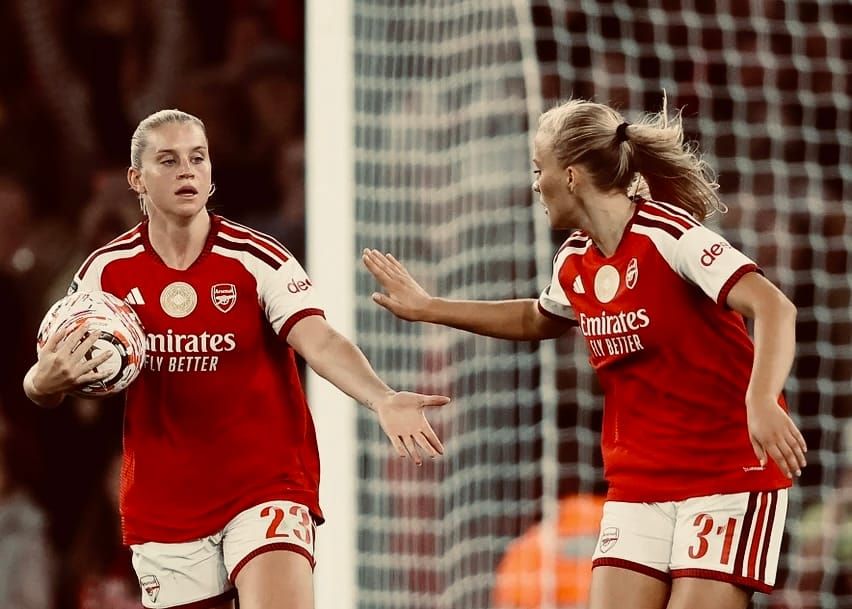
There was also the penalty shout involving Cerci in stoppage time. I’ve watched it again and I still think Arsenal have a reasonable argument there, but it wasn’t given and ultimately we didn’t need it for the equaliser because in the 94th minute Leah played an amazing ball towards the far post and Smilla Holmberg arrived to volley it in.
It’s a fantastic finish from a 19-year-old who’d already changed the game after coming on and we’ll come back to her because I think she might also tell us something about one of the solutions to Arsenal’s problems.
But 1-1 was how it finished.
And this is where I want to spend most of this article, because I don’t think we need another long discussion about Arsenal facing a low block.
Renée summed the problem up pretty well afterwards when she said Arsenal weren’t turning dominance into danger, and I think that’s the important distinction.
Because Manchester United weren’t always in a low block.
There were moments when Arsenal won the ball high and United weren’t organised. There were moments in transition when there was space ahead of us. Arsenal forced 18 high turnovers in this game and produced only 3 shots from them, with no shots recorded from fast breaks.
That’s a big problem.
If you win the ball while the opposition is disorganised but don’t attack quickly enough, eventually they get organised. The spaces disappear, the middle becomes crowded and you’re back to trying to work your way through ten players behind the ball.
So maybe my question after the Palace game was slightly wrong.
It isn’t only, “how do Arsenal become better at breaking down a low block?”, it’s also, “how do Arsenal stop giving teams enough time to build one?”.
The numbers make that fairly clear.
Arsenal had 16 shots against United but only 6 on target and finished with an expected goals figure of around 1.4. More interestingly, around 0.6 of that xG came from corners, so for all the possession and territory, Arsenal weren’t consistently creating particularly good chances from open play.
I don’t think this is simply a finishing problem.
Renée spoke afterwards about decision-making, technical execution and ruthlessness and obviously all of those things matter, but the speed of Arsenal’s attacking play is becoming difficult to ignore. We can move the ball pretty well across the pitch, but there are too many occasions when the extra pass allows the opposition to recover.
That’s where I thought Smilla Holmberg made such a big difference.
When she came on, there was very little hesitation. She received the ball and wanted to go just bomb forward. She attacked Sandberg, got outside her and crossed early. Renée said afterwards that was precisely why she’d introduced her. She wanted Smilla’s speed, her one-v-one ability and her crossing because she wanted to give United a different problem.
And it worked.
That doesn’t mean the answer is simply to start Smilla Holmberg every week. She’s 19 years old and we’re three league games into her first proper full season in England. But I do think Arsenal need more of what she brought to this particular game, regardless of who provides it.
Move the ball quicker when the space appears. Run at somebody before they’ve got support behind them. Put the cross in before the penalty area contains six defenders. Occasionally take the riskier forward pass rather than recycling possession and beginning again.
There’s also a selection question because Renée explained that starting Russo behind Blackstenius was deliberate. Arsenal expected to spend a lot of time in United’s half and the idea was to get two strikers into the penalty area when the ball came in from wide areas.
I can understand the logic, but I’m less convinced by what it produced.
If you’re going to sacrifice some of Russo’s presence as the number nine because you want two forwards attacking crosses, then the quality and timing of those crosses becomes absolutely crucial. Too often United were already back and organised by the time Arsenal delivered the ball and Maya Le Tissier and the defenders around her dealt with it extremely well.
So I don’t think Arsenal necessarily need to rip up the attacking plan, bit they absolutely do need to execute it much faster.
Is that the lesson from these last two games? Against Palace we spent a lot of time asking how Arsenal could find a way through a packed defence. United have given us another possibility to consider.
Don’t let it become packed in the first place.
The substitutions are worth talking about because my immediate feeling watching the game first time was that Arsenal had waited too long to change it, but having gone back through the timings, I don’t think that’s entirely fair of me.
Renée made the first changes in the 58th minute, bringing on Kim Little and Holmberg for Mariona and Smith. That’s not late and as we’ve just discussed, Smilla immediately started causing problems on the right.
Where I do think there’s a reasonable question is what happened next.
United scored in the 66th minute and Cerci and Foord arrived around four minutes later for Blackstenius and Baum. Kelly then came on for Batlle with roughly ten minutes remaining, so by the end Arsenal had committed just about everything they had to finding a goal.
What surprised me was that Géraldine Reuteler never came on.
We’ve spoken a lot about Reuteler since she arrived and one of her strengths is exactly what Arsenal seemed to be missing here. She can receive the ball in tight spaces, combine quickly and move between midfield and attack. In a game where United were making the centre of the pitch so difficult to play through, I thought she might have offered something different.
Cerci made complete sense too. She’s a different type of striker to Blackstenius and almost immediately gave United another physical problem in the box. She got on the end of one Holmberg cross, had the late penalty appeal and there were a couple of occasions when Arsenal tried to find her more directly.
So I don’t think the evidence supports saying Renée simply sat there and allowed the game to drift. She changed it before Arsenal went behind and changed it again very quickly afterwards.
But that said, does she need to become more willing to change the type of game Arsenal are playing, rather than simply changing the players in it.
Because this squad has options.
Holmberg gives you directness and width. Cerci gives you a different target through the middle and superior aerial threat. Reuteler gives you movement and combination play between the lines. Kelly can deliver from wide areas and Foord will run directly at defenders.
That’s potentially the positive in all of this. Arsenal aren’t short of alternatives.
The challenge for Renée now is recognising which one the game needs early enough to make it count.
There are positives here as well and I don’t want to lose those simply because dropping four points in two home games is supremely frustrating.
Misa was excellent. We talked before the season about the competition Arsenal suddenly have in goal and she’s making a very strong case for keeping the shirt. The two saves from Terland in the first half mattered, but I also really like what she’s giving Arsenal with the ball.
That pass to Ona before the Blackstenius header is exactly the sort of thing we’ve just been talking about. United weren’t set, Misa saw the run and instead of passing to her centre backs to start another passing move through to the midfield, she went straight over the lot of them, and Arsenal nearly scored from it.
Holmberg is obviously another big positive. She’s 19, she’s only had half a season in England, but she already looks completely comfortable taking responsibility in games. The goal will get the attention, as it should because it’s a superb finish, but I was more encouraged by everything she did before it. She came into a difficult game and immediately tried to change it.
And Arsenal did respond to going behind.
I’d much prefer they hadn’t needed the goal to produce that urgency, which is something Renée will need to look at, but the final 20 minutes showed what this team can do when the tempo increases. United were suddenly having to defend continuously and Tullis-Joyce had to make some very good saves to keep them out.
United deserve credit too. They’d just lost 5-0 to Chelsea, Eva Olid spent the week working on their defensive organisation and the improvement was enormous. Sandberg defended Smith well, Le Tissier was excellent centrally and Tullis-Joyce made the saves when Arsenal did get through.
So this wasn’t simply Arsenal playing badly against a poor Manchester United side.
United had a plan and executed it well. The frustration for Arsenal is that they had enough opportunities to make that plan much more difficult than it eventually became.
And that brings me to where Arsenal are after three league games.
I don’t think there’s any value in turning this into a crisis. Arsenal are still unbeaten and we’re still early in the season, with a squad containing a lot of new players who are still developing those relationships with each other.
But four points dropped at home against Crystal Palace and Manchester United can’t simply be brushed aside either. Renée described them as four lost points herself and if Arsenal want to win the WSL, these are the games where you just cannot keep leaving points behind.
The encouraging part is that I don’t think we’re looking at a problem without obvious solutions.
Play forward more quickly when the opportunity is there. Make better use of the turnovers we’re already creating. Recognise when a defence has become comfortable with the problem we’re giving them and change that problem. Holmberg showed us what that can look like on Saturday.
There will also be games where patience is required and where Arsenal have to keep moving an opponent around until the space appears. But patience and slow football aren’t the same thing and I think that’s an important distinction for this team at the moment.
So I’m frustrated by the result, as ever more interested than worried by what we’ve learned from it.
Palace gave Arsenal a warning. Manchester United have given Renée more evidence about what needs improving.
We don’t have very long to dwell on it because Arsenal are back in action tomorrow night in the Champions League so I’ll leave this one there.
But we absolutely need to start seeing more from this side and Renée needs to seriously consider what she is going to do against Køge, because undefeated with a host of draws is not good enough for a team with this amount of quality and ambition.