
Élisa de Almeida, Social Media and the Question We Should Ask Before We Believe Anything
After Arsenal signed Élisa de Almeida, allegations about her political beliefs spread rapidly across social media. I went looking for the evidence, and what I found was a useful reminder that repetition isn’t proof, particularly when somebody’s reputation is involved.

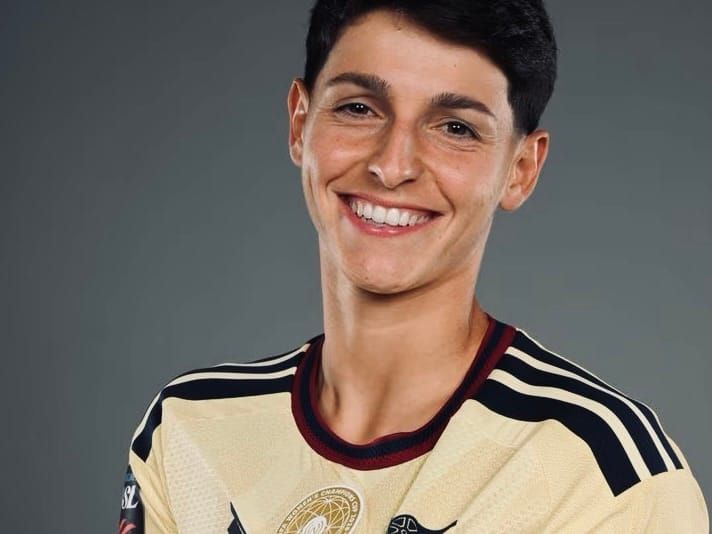
Over the last few days, since Arsenal signed Élisa de Almeida, I've seen her described as transphobic, as a Zionist, as far-right and as someone whose values don't belong at Arsenal Football Club.
I've also had people message me directly because they're upset that we've signed her.
Now, Trailblazers is primarily about football. I don't particularly want this website or the podcast becoming a weekly examination of footballers' political beliefs, and I'd much rather be talking about what Élisa might give Renée Slegers at centre-back.
But when there's this much reaction and some of you, particularly some of our younger Trailblazers, are clearly worried about what you're reading, pretending none of it exists doesn't feel particularly responsible either.
So I went looking for the evidence.
Before we get anywhere near Élisa herself, there's something I want you to remember whenever something like this happens online.
Seeing the same thing repeated hundreds of times doesn't make it true.
It might be true - but repetition isn't evidence.
One person posts something on X. Somebody screenshots it and puts it on Instagram. Somebody else repeats that on Reddit. Another account makes a TikTok about it and within a few hours you've got hundreds or perhaps thousands of people apparently confirming the same story.
Except they aren't necessarily confirming anything. All of them may ultimately be relying on the same original claim. So instead of asking how many people are saying something, there's a much more useful question we can ask:
"How do we know?"
When I followed this particular story backwards, I did find something real at the centre of it. In March 2025, Élisa appeared in a short International Women's Day video supporting a French organisation called Éclats de Femme, which works with women who have experienced sexual and sexist violence.
The organisation was founded by Claire Geronimi, and Geronimi has documented political associations which have themselves attracted considerable controversy, including connections to figures and organisations on the French right and far right.
That happened. But the problem comes when we move from establishing that fact to deciding what Élisa personally believes.
Did Élisa appear in material supporting an organisation whose founder has controversial political associations? Yes, she did.
Does that establish that Élisa shares those political views? No, it doesn't.
And I don't mean, “No, she definitely doesn't.” I mean that I haven't found the evidence that allows me to tell you she does.
I've looked for public statements, interviews and posts from Élisa concerning trans people, Israel and Palestine, Marine Le Pen and the French far right, and I haven't found any reliable primary evidence which allows me to say, “Yes, Élisa de Almeida holds those views.”
That doesn't prove the opposite either - I don't know what she privately believes. And unless somebody produces evidence we've not yet seen, neither do you, neither does anyone in fact.
I've also seen people argue the other way, suggesting that none of Geronimi's political associations were public when Élisa appeared in the video and therefore she couldn't possibly have known anything about them.
That isn't quite right either. Some of those associations were already public.
Maybe Élisa knew, maybe she didn't. Maybe she was simply interested only in the organisation's work with victims of violence and knew very little to nothing about the politics of the person behind it.
Again, I don't know.
I think that's where we occasionally get ourselves into trouble, because saying “I don't know” can feel terribly unsatisfying when everyone around you seems incredibly certain.
I had a conversation with one of our younger Trailblazers which brought this into focus for me better than almost anything else I've read. She was really unhappy about the signing because she'd heard Élisa had shared videos connected with some of these views, so I asked her where she'd seen them.
She hadn't actually seen them, she'd only heard that Élisa had shared them.
So we went one step backwards. What were the videos? Where were they posted? What did Élisa actually say? Did she add anything herself?
What I really liked was that this young lady didn't interpret me asking her those questions as me defending Élisa. She stopped and thought about what she actually knew, and gradually the position changed from “this is what Élisa believes” to “perhaps I don't yet have enough evidence to know what Élisa believes.”
She was still uncomfortable with the signing and that's perfectly reasonable.
Her view became that even if Élisa didn't share those politics, she was disappointed that a professional footballer might lend her name to an organisation without doing any research about who was behind it. Now that's an opinion based on something we can actually discuss, although even there we should be careful because we still don't know what research Élisa did or didn't do.
Then she said something I thought was really insightful. I'm paraphrasing because this was a private conversation, but essentially she wondered whether people had become so angry about hateful attitudes towards groups they care about, that the anger made it easier to believe allegations which appeared to confirm what they were already frightened of.
I think there's something in that for all of us. If you encounter racism, homophobia, transphobia, misogyny or any other form of hatred, of course it can make you angry. But anger doesn't absolve us from being careful about what we subsequently accuse someone else of believing.
Social media rewards the simple version.
“Footballer holds horrible political views” travels very quickly and easily.
“Footballer appeared in material supporting an organisation whose founder has controversial political associations, but we don't currently know what the footballer knew about or believes regarding those politics” is considerably less juicy or algorithm-friendly!
Unfortunately, less algorithm-friendly can still be accurate.
So where does that leave us with Élisa de Almeida?
We know Élisa appeared in material supporting Éclats de Femme. We know there are legitimate questions surrounding the political associations of its founder.
What I cannot currently establish from reliable evidence is that Élisa herself is transphobic, that she's a Zionist, that she supports Marine Le Pen or that she shares the political beliefs of everybody connected with that organisation.
If somebody has primary evidence establishing otherwise, send it to me, I'll look at it. And if the evidence changes, what I say changes - that's how this should work.
You don't need to believe something because I say it. You don't need to believe it because somebody with fifty thousand followers on X says it and you don't need to believe it because five hundred people underneath an Instagram post apparently agree with one another.
Just keep asking the same question.
"How do we know?"
Sometimes you'll find the evidence and discover the claim was right. Sometimes you'll discover the story has changed somewhere along the way.
And sometimes the most accurate answer available to us will simply be that we don't know yet.
That's not sitting on the fence - it's simply refusing to invent the missing parts.